If you’ve ever worked in wastewater treatment, oil and gas production, or food processing, odds are you’ve crossed paths with a 3 phase decanter centrifuge. These machines are absolute workhorses for separating three distinct phases—oil, water, and solids—from a mixed slurry, and most of the time, they do the job well. But here’s the thing: anyone who’s actually run one long enough will tell you they come with a whole set of headaches that no spec sheet or sales brochure will tell you about. As someone who’s been supplying these units for 12 years, I’ve seen more than a few teams get tripped up by these challenges, and today I’m breaking down the real, day-to-day issues that no one warns you about. 3 Phase Decanter Centrifuge
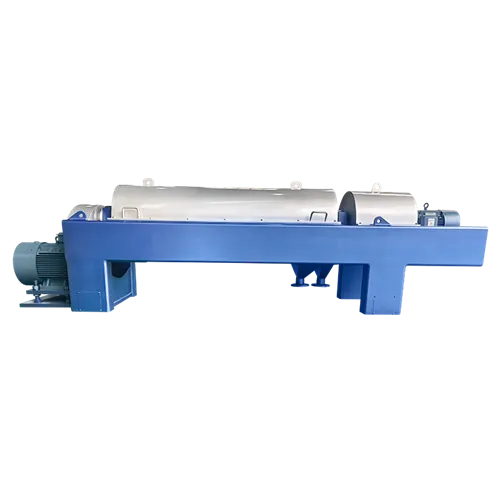
First off, let’s get one thing straight: a 3 phase decanter isn’t just a regular 2 phase centrifuge with a fancy extra port. It’s a tightly tuned system, and the balance that works for one slurry type might fall apart completely for another. The first big challenge we run into is phase separation inconsistency. A lot of operators walk into this assuming that oil, being less dense than water, will just rise right to the top. But that only works if the mixture’s density is uniform and the particle sizes are all within a narrow range. If you’ve got a slurry that’s been sitting in a storage tank for a few days, the solids will start to settle unevenly, making the oil layer thicker in one spot and thinner in another. When that happens, the centrifuge’s scroll (the part that pushes solids out) can end up dragging oil into the solid cake or letting small solid particles float into the oil layer, ruining your end products. I had a client in the offshore oil and gas space last year—they were handling produced water from a well that had sudden spikes in heavy wax particles. Their existing decanter was calibrated for low-wax slurry, so the wax would clump into the oil phase instead of separating out, and their oil discharge ended up with 8% solid contamination. That’s not just a nuisance; it’s a regulatory headache, especially for offshore teams who have to meet strict discharge limits.
Next up, there’s the problem of scroll solid buildup and wear. The scroll is the rotating screw that pushes the separated solids out of the centrifuge’s bowl, and it’s constantly grinding against the solids inside. For materials like sand, metal shavings, or even hard organic particles, that wear can get brutal fast. We had a client in the municipal sludge space who ran their decanter 24/7 for three months without a proper inspection, and the scroll flights had worn down by 4mm—enough that the gap between the bowl and scroll was off by almost a centimeter. That threw off the separation balance entirely, and they ended up with 30% more water in their solid cake, which made disposing of it way more expensive. The tricky part here is that this wear isn’t evenly distributed. Solids tend to accumulate on the lower half of the scroll, so that’s where most of the damage happens, but a lot of operators only do a full visual check once a year, which is way too slow. We’ve had clients skip regular inspections to save time, and they end up with unplanned downtime that costs them thousands of dollars an hour in lost production.
Then there’s the feed variability issue. Almost every slurry that comes through a 3 phase decanter changes composition over time. One day you might have a mix that’s 20% solids, 10% oil, and 70% water, and the next it’s 40% solids, 5% oil, 55% water. A lot of operators set their decanter’s speed, differential speed (the speed difference between the bowl and scroll), and feed flow rate once, and leave it there. That works for a few days, but not for long. When solids spike, the differential speed needs to go up to push more solids out, but if you don’t adjust it, those solids start to back up in the bowl, which can cause the centrifuge to vibrate so hard it trips the power. I remember a food processing client who was separating olive mill slurry—their feed had variable amounts of olive pit particles, and they kept their decanter set at a fixed differential speed. One week, the pits made up 35% of the feed, and the vibration got so bad that they cracked the bowl’s shaft, leading to a two-week shutdown. The fix was simple: build a small control loop that monitors feed solids and automatically adjusts differential speed, but a lot of older decanters don’t have that tech, and retrofitting it adds extra cost that no one budgets for.
Don’t even get me started on oil phase purity issues. A lot of clients buy a 3 phase decanter expecting the oil discharge to be clean enough to reuse or sell, but that’s rarely the case right out of the box. The main culprit here is emulsions. If the oil and water mix to form a stable emulsion, they won’t separate properly, and tiny oil droplets will get trapped in the water phase, or vice versa. Some emulsions are caused by surfactants in the slurry—like detergents in industrial wastewater or waxes in produced water—and they can be super sticky to break down. We had a client in the metal finishing space who was separating coolant oil from machining wastewater; the coolant had surfactants that formed a tight emulsion, so their oil discharge was 25% water, making it worthless as a reusable product. They ended up having to add a chemical demulsifier, but that added $12,000 a month in chemical costs, plus it altered the slurry’s density, which messed with the separation balance. Another thing that messes with oil purity is the weir plates in the decanter. Most decanters have adjustable weirs that set the oil layer depth, but if you set them too high, you’ll end up with water in the oil; too low, and you’ll lose oil in the water phase. Getting that adjustment right takes a lot of trial and error, and even small changes in feed density can throw it off.
Solids disposal is another hidden challenge. A lot of operators think once the solids are pushed out of the decanter, their job is done, but that’s not true. The solid cake that comes out of a 3 phase decanter can have variable moisture content, depending on the slurry. If the solids have a lot of fine particles—like clay or silt—they’ll hold onto water, making the cake too wet to dispose of as non-hazardous waste, which means they have to pay higher hazardous waste fees. I had a construction client who was separating sand from concrete washout; their decanter’s solid cake had 45% moisture content, so they were paying $80 a ton to dispose of it, when they could have reused the sand for backfilling if the moisture was under 25%. The problem here was that the decanter’s bowl had too small a volume, so the solids didn’t have enough time to drain water out. It’s a design flaw that’s easy to miss when buying a decanter based on specs, but it ends up being a big ongoing cost.
And let’s not forget maintenance and operational knowledge. A 3 phase decanter isn’t a set-it-and-forget-it machine. It needs regular checks for things like gearbox oil levels, bowl vibration, and scroll flight wear, and most importantly, it needs an operator who knows how to adjust it. A lot of clients cut corners on training, and they end up running the decanter outside its optimal parameters, which leads to all the issues we talked about. For example, if an operator accidentally sets the feed flow too high, the slurry doesn’t have enough time to separate, so oil and solids get mixed in the water phase. I’ve had clients call me in after months of bad performance, only to find out the operator had never been trained on how to adjust the weir plates or differential speed. It’s not that the machine is bad—it’s that the team running it doesn’t know how to work with it.
Now, before you write 3 phase decanters off as a hassle, let’s be clear: they’re still the most efficient option for this kind of separation when set up and run right. The problems we’re talking about aren’t insurmountable—they’re just challenges that require the right setup, regular maintenance, and a little know-how. That’s where coming to us as your supplier makes a difference. We don’t just sell you a machine and walk away. We work with you to calibrate it for your specific slurry type, help you set up a regular maintenance schedule, and even provide operator training so you don’t end up with those unplanned shutdowns or bad product contamination issues. If you’re dealing with inconsistent separation, high wear costs, or purity issues with your oil, we can walk through your process, identify the gaps, and tailor a solution that fits your needs.
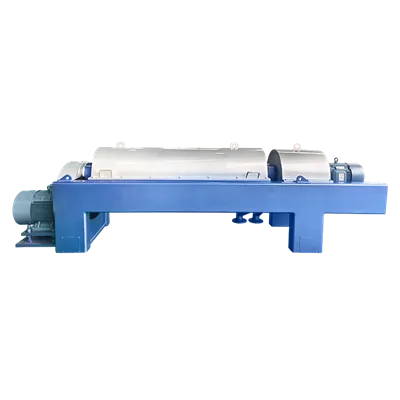
If you’re tired of fighting with your current 3 phase decanter, want to upgrade to a machine that’s built for your specific application, or just need to troubleshoot the headaches you’ve been dealing with, reach out to us to talk through your requirements. We’re here to help you make this work, not just sell you equipment.
Decanter Centrifuge References:
- M. Ilyas, A. Khurshid, and S. A. Khan, "Challenges in Solid-Liquid-Oil Separation Using Centrifuges for Industrial Wastewater Treatment," Journal of Environmental Engineering, vol. 148, no. 5, pp. 04022027, 2022.
- R. B. Thorat, Centrifugal Separation: Principles and Industrial Applications, 2nd ed., Elsevier, 2019.
- Offshore Technology Report, "Produced Water Treatment: Separation Challenges and Best Practices," International Association of Oil & Gas Producers, 2021.
- Food and Agriculture Organization, "Separation of Slurries in Food Processing: Equipment and Operational Guidelines," FAO Agricultural Services Bulletin, no. 178, 2020.
- N. Li, W. Wang, and L. Zhang, "Scroll Wear in Decanter Centrifuges: Causes, Monitoring, and Mitigation Strategies," Wear, vol. 486-487, p. 204098, 2022.
Lishui Yuanrong Environmental Protection Equipment Co., Ltd.
As one of the most professional 3 phase decanter centrifuge manufacturers and suppliers in China, we have world-leading production equipment and strong manufacturing capabilities. Please feel free to buy customized 3 phase decanter centrifuge from our factory. Also, quotation is available.
Address: Lot 6-1, Block 15, Wanyang Zongchuang City, Lishui, Zhejiang, China
E-mail: 361184920@qq.com
WebSite: https://www.yrhdc.com/
