If you’ve ever walked through a power distribution room, a control panel factory, or even a small-scale electronics repair shop, you’ve probably spotted those small, rectangular pieces of plastic holding wires tight and organized. Those are spring terminal blocks, and for a long time, I worked under the assumption that they all came in one color—pale, neutral gray. That was until a customer of mine, a lead electrical engineer at a renewable energy firm, hit me with a question that made me rethink everything: “Do spring terminal blocks come in different colors, and if so, why should I care?” Spring Terminal Block
As a spring terminal block supplier, I get this question a lot, and the answer isn’t as simple as “yes” or “no.” It’s tied to material science, industry standards, practical workflow needs, and even safety protocols that shape how every terminal block is manufactured, sourced, and used. Let me walk you through what I’ve learned over the years, straight from the shop floor and the projects our customers tackle every day.
First, let’s ground this in the basics: what a spring terminal block is, for anyone who’s not in the electrical game. A spring terminal block is a device that lets you connect multiple wires to a single circuit or component without having to strip every wire end or use a screwdriver to tighten screws. A small lever (the “spring” part) releases a clamping mechanism; when you insert a wire and release the lever, the spring clamps down tight, creating a reliable, vibration-resistant connection. These blocks are used everywhere: from residential circuit breakers to factory automation systems, solar inverters, and even electric vehicle charging stations.
Now, back to color. The short answer is: yes, spring terminal blocks absolutely come in different colors, but not just for looks. For most of my early years in this business, we only offered gray terminal blocks—gray polyamide, to be precise, the go-to material for electrical components because it’s flame-retardant, can handle extreme temperatures, and doesn’t degrade from UV exposure. Gray is neutral, cheap to produce in large batches, and blends into most control panels without drawing unwanted attention. But as our customer base grew, we started getting requests for other colors, and we quickly learned that color isn’t a cosmetic choice—it’s a functional one.
Let’s start with the most common alternative color: orange. When we first launched orange spring terminal blocks, we thought it was a trend, but it turned out to be a game-changer for customers working with high-voltage circuits. The International Electrotechnical Commission (IEC) sets strict color standards for electrical components, and orange is designated for circuits rated above 50V in many regions. For an engineer wiring a control panel, picking out a high-voltage terminal by sight (even from across a noisy, dimly lit factory floor) avoids the dangerous mistake of mixing up a 24V low-voltage circuit with a 230V power circuit. I remember one customer, a automation integrator, told us that switching to orange terminal blocks for high-voltage lines cut their on-site wiring errors by 40% in the first month. That’s not a small number for a industry where a single miswire can shut down a production line for days.
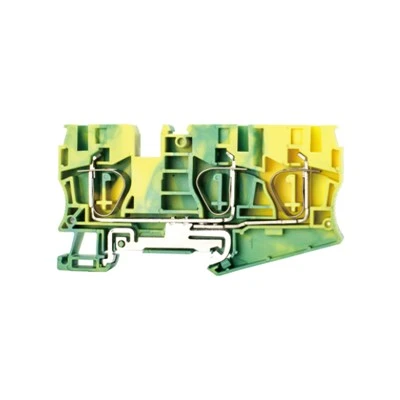
Then there’s green and yellow. Wait, that’s two colors, but almost always used together—green-yellow striped terminal blocks. This is another IEC standard, reserved exclusively for protective earth (ground) connections. Ground wires are non-negotiable in any electrical system, and marking their terminal blocks with that iconic green-yellow stripe makes it impossible to miss. No more connecting a ground wire to a neutral terminal, a mistake that can lead to shock hazards or damaged equipment. We once had a customer who was retrofitting a 10-year-old factory and found that old gray terminal blocks had been used for ground connections, leading to multiple near-misses for electricians. After switching to green-yellow blocks, their safety inspection passed on the first try, which saved them thousands in downtime.
Beyond these standard safety colors, we also offer custom colors for specific industry needs. Light blue, for example, is used for neutral terminals in many European and global IEC applications, helping to separate neutral from line and ground. In the solar industry, where every circuit is labeled for traceability, we’ve supplied red terminal blocks for DC positive connections and black for DC negative connections, per solar industry guidelines. What’s interesting here is that these colors aren’t just picked at random—they’re standardized across the board, so a solar installer in Germany uses the same color coding as one in Australia, making it easy to service systems anywhere in the world.
Now, you might be wondering: how do manufacturers make terminal blocks in different colors, and does that affect their performance? Let’s talk materials, because that’s where a lot of people get confused. The base material for spring terminal blocks is still flame-retardant polyamide (PA6.6), which is non-negotiable for safety. To change the color, manufacturers add pigment masterbatch during the extrusion or molding process. The key here is that the pigments used have to meet strict electrical and thermal standards—they can’t conduct electricity, they can’t break down at high temperatures, and they can’t fade over time from UV exposure. That’s why not all colored terminal blocks on the market are equal. Cheap, low-quality pigments can fade, crack, or even leach harmful chemicals when exposed to extreme heat, which defeats the entire purpose of using color for safety.
As a supplier, we test every batch of colored terminal blocks for temperature resistance, UV stability, and electrical insulation. I’ve seen customers buy cheap gray terminal blocks from overseas suppliers that started fading after six months of outdoor use on a solar farm, making their color-coding useless. That’s a problem we don’t want our customers to face. When we add pigment to our blocks, we use only UV-stabilized, non-conductive pigments that meet UL 94 V-0 flame resistance standards, so color doesn’t compromise safety.
Another common question I get: do I really need colored terminal blocks? Can’t I just use a label on a gray block? Technically, yes, but labels have their limits. In a busy control panel with dozens of wires running side by side, a small paper or plastic label can tear, smudge, or fall off, especially in environments with vibration, dust, or moisture. A color-coded terminal block is a permanent, visual marker that you can see from a distance, even if the panel is lit poorly or covered in grime. I had a customer who works in food processing, where control panels get sprayed with water and cleaning chemicals weekly. They used to rely on labels, but after a year, half were unreadable. Switching to color-coded blocks meant no more re-labelling, and fewer errors during maintenance. That’s been a huge win for them.
Of course, not all colored terminal blocks are for industrial or high-voltage use. For smaller applications, like residential wiring or hobbyist projects, you can even find spring terminal blocks in white, black, or clear. White is popular for low-voltage applications, like audio equipment or doorbells, where you want a neutral look. Clear terminal blocks are great for educational settings, where students can see the internal spring mechanism and learn how the connection works.
As a supplier, we’ve seen the demand for colored terminal blocks grow steadily over the past five years. More industries are adopting color-coding to improve safety, reduce downtime, and streamline maintenance. What started as a cosmetic tweak has become a core part of our product line, and it’s made our job more rewarding—knowing that the colors we offer aren’t just pretty, but they help keep electricians safe, projects on schedule, and systems running smoothly.
If you’re working on a project and wondering which terminal block color is right for you, the first step is to check the industry standards that apply to your application. IEC, UL, and NEC (National Electrical Code, which applies in the U.S.) all have specific color guidelines for different circuit types. But if you’re not sure, or if you have unique needs for your project, our team is here to help. We’ve worked with everyone from small electricians to large aerospace manufacturers to find the right terminal block solution for their needs, whether that’s standard safety colors, custom hues for brand consistency, or blocks that can handle extreme environments.

Don’t hesitate to reach out to our team to discuss your spring terminal block requirements. We can walk you through our product offerings, explain the benefits of color-coding for your specific application, and help you source the right parts for your project, no matter how big or small.
Straight Insertion Branch Terminal References
International Electrotechnical Commission (IEC) 60947-7-1: Low-voltage switchgear and controlgear – Part 7-1: Ancillary equipment for switchgear and controlgear – Terminal blocks for copper conductors
Underwriters Laboratories (UL) 1059: Standard for Terminal Blocks
National Electrical Code (NEC) Article 250: Grounding and Bonding
Zhejiang Weide Electric Co., Ltd.
Zhejiang Weide Electric Co., Ltd. is one of the most professional spring terminal block manufacturers and suppliers in China, featured by quality products and low price. If you’re going to buy the newest spring terminal block, welcome to get free sample from our factory. We also accept customized orders.
Address: No.555, South Binhe 2nd Road, Yueqing City, Zhejiang Province, China
E-mail: zjwdir@wdirele.com
WebSite: https://www.chweide.com/
